NEET 2026 Paper Leak: What the Timeline Reveals About Accountability
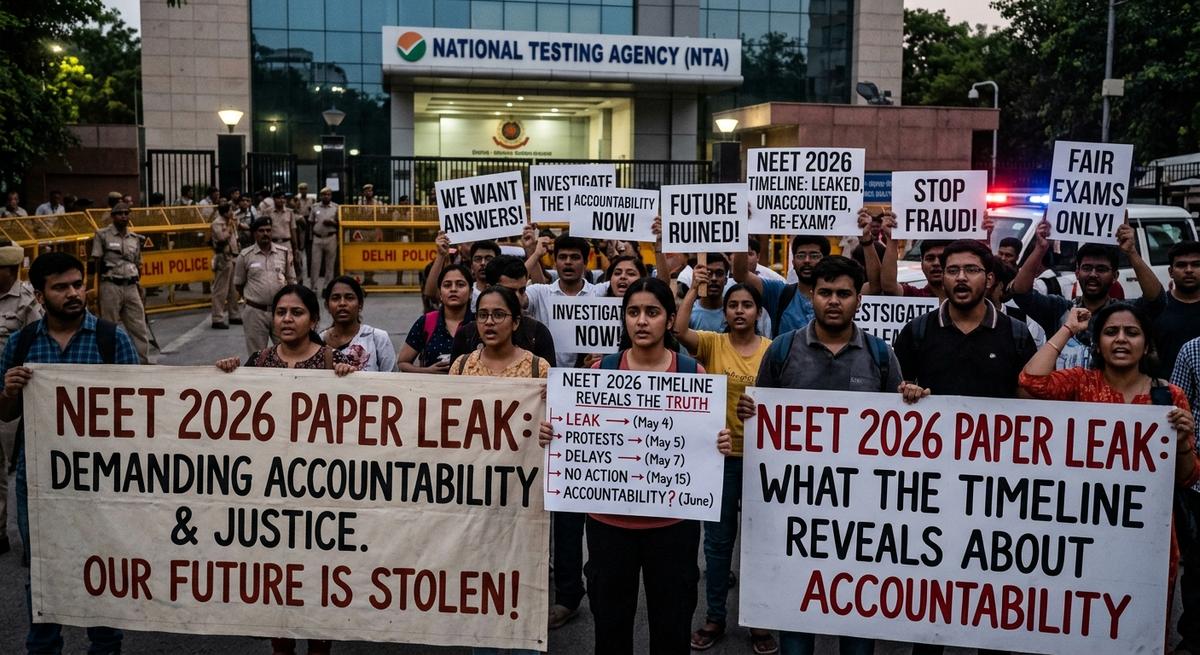
Over 2.2 million students sat NEET on 3 May 2026. The exam was cancelled in nine days. The political response took eleven weeks, and a march on Parliament.
The Hook
On 3rd May 2026, more than 2.2 million teenagers walked into examination halls across India. Most of them had given up two years of their lives for that one morning. Some had given up three.
Nine days later, the National Testing Agency cancelled the paper.
Here is the part that should make you angry. The leak was not cracked open by the NTA nor was it caught by the Ministry of Education. It was flagged by a chemistry teacher in Sikar, Rajasthan, who sat down with a "guess paper" that had been circulating before the exam, compared it against the real thing, and found that the questions matched.
A private tutor did the state's job. Again.
This Was Not a Breach, It Was an Exit
We use the word "leak" and it sounds like water seeping through a crack. It was nothing so passive.
The Print reported an overlap of up to 120 of 180 questions between the circulating material and the actual paper. The whistleblower's own count of matching items ran to roughly 140. Separately, the Rajasthan Police Special Operations Group traced a mock paper from a coaching institute in Latur, Maharashtra, in which 42 of 45 questions turned up in the real exam.
Now ask the obvious question. Who had that kind of access?
The CBI's answer, filed in court on 28 July, names three NTA subject experts. Not hackers. Not couriers. The agency's own appointees, the people trusted to translate, back-translate and proofread the papers. According to the investigators, one of them wrote out the entire chemistry question set on small slips of paper and walked out of the confidential section in Delhi with them in his pocket. A Pune school headmistress, serving as a physics expert, is alleged to have reconstructed questions from memory and passed them on.
The material then moved through coaching operators and doctors. Families reportedly paid between ₹2 lakh and ₹10 lakh for access. One early arrest in Nashik involved ₹15 lakh.
And then the detail that should end any argument about whether this was a one-off. Investigators concluded that the same network had compromised the NEET-UG 2025 paper too.
So 2026 was not a system failing for the first time. It was a system that had already failed once, quietly, and did not notice.
Who Actually Paid / The cost was carried by families, not by the system
The NTA announced a re-exam for 21 June and a refund of application fees. Read that sentence again and notice what is being counted as the damage.
A fee refund does not cover seven more weeks of coaching. It does not cover hostel rent, or a second round of travel, or the parents who took loans in 2024 on the assumption that this would be over by June 2026. It does not cover the repeat candidate on attempt three who now has to hold an entire year of chemistry in his head for another forty-nine days without cracking.
In a system that runs almost entirely on private coaching, a seven-week delay is not a neutral inconvenience. It is a wealth transfer. The families with money absorbed it. The families without money absorbed it differently.
Media reports documented at least three deaths by suicide among aspirants in the weeks after the cancellation. Student bodies across the country reported widespread distress. Those reports are not decoration for an argument and they should not be used as one. But they are on the record, and they were the specific basis on which protesters later demanded compensation for affected families.
Nobody in India lost a year. Two million households did. The aspirants who had dreamed of becoming Doctors did, their parents did. They paid for it.
The Timeline That Says Everything
Put the dates next to each other. This is the whole story.
- 3 May: The exam is held.
- 12 May: NTA cancels it. CBI takes over. Nine days. Genuinely faster than 2024, and worth saying so.
- 15 May: Education Minister Dharmendra Pradhan admits a "breach in the command chain" and announces a move to computer-based testing from 2027.
- 25 May: The Supreme Court asks whether the reforms recommended after the 2024 leak were ever actually implemented. Nobody has answered that in public since.
- 6 June: Students begin protesting at Jantar Mantar.
- 28 June: Sonam Wangchuk begins an indefinite hunger strike.
- 18 July: Police remove him from the site to hospital on day twenty.
- 20 July: Tens of thousands march on Parliament. Baton charges. Tear gas. Between sixteen and eighteen Delhi Metro stations shut. Internet suspended near Parliament. Twenty CRPF companies airlifted into the capital. Police report 118 personnel injured. Hospital sources and organisers report injuries past 100 on the other side.
- 23 July: The Prime Minister speaks publicly about the leak for the first time.
- 25 July: Pradhan resigns.
Eleven weeks between the leak surfacing and the first word from the Prime Minister. Three days between the march on Parliament and that first word.
The resignation did not follow the CBI establishing that NTA insiders were involved. It followed the capital being brought to a halt.
That is the frustrating part, and it deserves to be said plainly rather than shouted. The administrative machinery moved. The political leadership moved only when the cost of not moving landed on it.
The Arrogance
In late June, with a hunger strike running at Jantar Mantar and students camped in forty-degree heat, the Education Minister described the protesters as a "B-team of terrorists".
There were schoolchildren and their parents.
His resignation letter a month later was addressed to his "young friends" and took moral responsibility while defending the government's handling of the crisis. Both halves of that letter are in the public record. You are allowed to notice the distance between them.
What Actually Changed, and What Did Not
Parliament passed the Public Examinations (Prevention of Unfair Means) Amendment Act at the end of July. It raises imprisonment for examination fraud from three to five years to five to ten years, raises fines substantially, mandates special fast-track courts in every state, and sets a two-month investigation deadline. Reported fine ceilings vary across coverage, so check the gazetted text before quoting a figure.
It is a real law. It is also, entirely, a punishment-side law.
It raises the price of getting caught. It does nothing about the fact that three subject experts walked confidential material out of a secure room in Delhi. No amount of prison time fixes a door that does not lock.
And moving NEET to computer-based testing in 2027 fixes transport and printing. It does not fix the design decision underneath all of this: two million medical careers concentrated into one paper, on one day. That concentration is what makes the exam worth compromising. Change the format and the incentive survives intact.
The Blunt Verdict
India got a minister's resignation. It did not get an accountability system.
The difference matters, because look at what this one cost. A viral protest movement that only existed because a judge called unemployed young people cockroaches in open court. A twenty-six day hunger strike by a nationally known figure. A march that shut down central Delhi. International coverage. Injuries on both sides of a police barricade.
All of that, to produce an outcome that a functioning departmental inquiry would have delivered in June, in a conference room, with nobody in hospital.
We cannot run a republic where the only working feedback mechanism is a crowd large enough to stop traffic.
The Hot Take
Stop asking who leaked the paper. The CBI has fourteen people in custody and a chargesheet with 360 witnesses. That question is being answered.
Ask the questions nobody in the Ministry of Education wants on the record instead.
Which of the 2024 committee's recommendations were implemented, and on what date? Who signed the protocol that let subject experts leave the confidential section unsupervised? Was the 2025 compromise detected at the time, and if not, who was supposed to detect it? The CBI called the NTA's negligence unacceptable. What departmental action followed that word?
Those answers already exist inside a building in Delhi. Producing them does not require anyone to march anywhere, go hungry for twenty-six days, or get hit with a lathi on a Monday morning.
That nobody has produced them is the actual scandal. The leak was a crime. This is a choice.
- Nirvik