The Graph Goes Up, But We Get Poorer: The Great Wealth Illusion
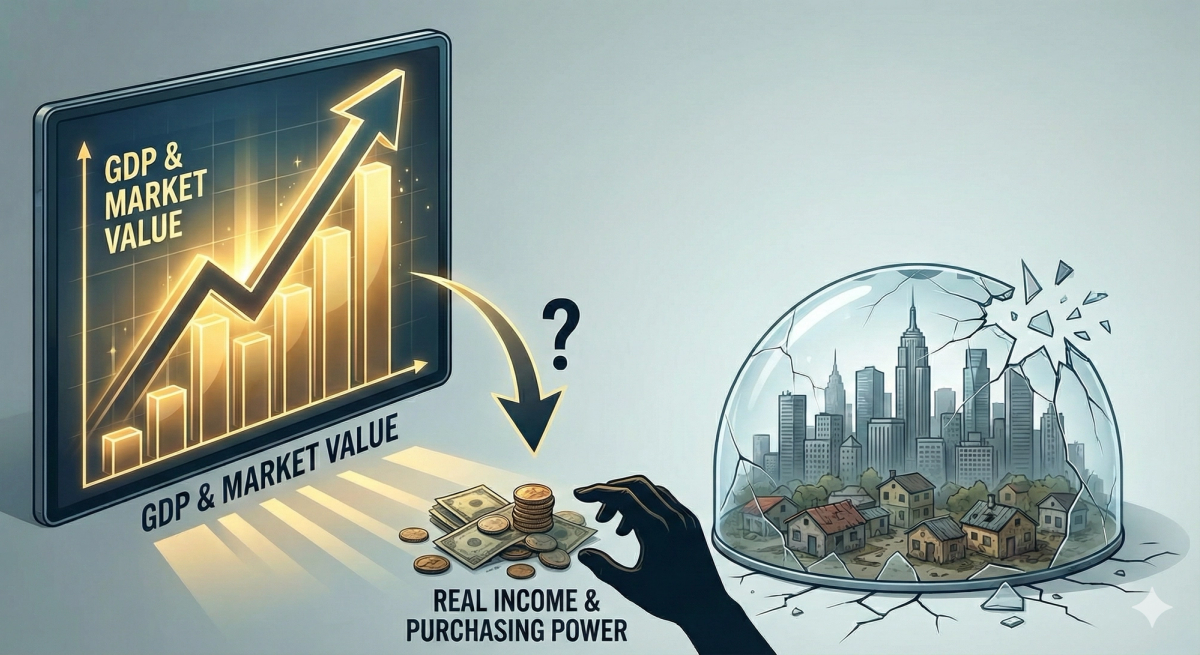
The Disconnect
Recently, the S&P 500 and the NIFTY 50 hit record highs. The politicians tweeted about the "fastest growing major economy", news channels and the government reports echoed the same.
And yet, you felt poorer than you did five years ago.
You aren’t crazy. And you aren’t bad at math. You are simply the victim of the greatest magic trick in modern history: The divergence between the Economy and the Market.
The "Cantillon Effect" (Simplified)
To understand why your salary feels like monopoly money, you have to understand a concept from the 18th century called the Cantillon Effect.
When central banks inject money into the system (as they have done relentlessly), that money doesn't appear magically in everyone's pockets at the same time.
- It goes to the banks and institutions first.
- They use it to buy assets (Stocks, Real Estate).
- By the time that money trickles down to your paycheck (in the form of a 3% raise), the prices of the things you need to survive (Houses, Food, Energy) have already risen by 20%.
The result? The "Graph" goes up because there is more money chasing the same assets. But You get poorer because your wages are the last thing to inflate.
The Indian Context: The "K-Shaped" Reality
Nowhere is this illusion more brutal than in India right now. We are witnessing a classic "K-Shaped Recovery."
- The Upper Arm of the K: If you own stocks or real estate in South Mumbai, Gurgaon, or Indiranagar, you are richer than ever. The NIFTY is booming because foreign capital loves the "India Story."
- The Lower Arm of the K: Look at the entry-level IT engineer. In 2010, a fresher's salary at a mass recruiter (TCS/Infosys) was ₹3.5 Lakhs. In 2026? It is still hovering around ₹3.5–4 Lakhs.
Think about that. In 15 years, the cost of a flat in Bengaluru has tripled. The price of milk has doubled. But the starting wage for the country's "premier" industry has remained flat.
That is not growth. That is silent stagnation masked by a booming stock market.
The Cost of Living vs. The Cost of Thriving
The government likes to point to CPI (Consumer Price Index) to say inflation is low. But look at what CPI measures: cheap electronics, data plans, and basic grains.
Now look at the Cost of Thriving:
- The cost of a home in a Tier-1 city.
- The cost of private schooling (which is practically mandatory now).
- The cost of medical care without insurance.
These haven't gone up by 5%. In many sectors, they have doubled. We have created an economy where 5G data is virtually free, but dignity is expensive.
The "Steel Man" Argument
Now, to be fair to the economists: Technically, the economy is growing. Innovation is happening. India's UPI infrastructure is a global marvel. We are not in a recession.
However... GDP growth driven by government capex and consumption by the top 10% is not broad based prosperity, it just shows that it is an economy that relies on the middle class EMI-ing their way through on a day to day life basis.
The Unfiltered Verdict
Stop looking at the Sensex to measure your financial health. That index measures the wealth of corporations, not the common man.
If you work for a living (Labor), you are fighting a losing battle against those who own things (Capital). The only way to win this game is to stop playing by the old rules.
- Stop saving in currency that is being debased.
- Stop believing that a "safe job" will outpace inflation.
- Start acquiring assets: gold, equity, or skills, that inflation cannot eat.
The graph will keep going up. Make sure you aren't the fuel that keeps it burning.
The Hot Take: If your "raise" was less than the real rate of inflation (approx 8-10% in metro cities), you didn't get a raise. You got a pay cut. Act accordingly.